
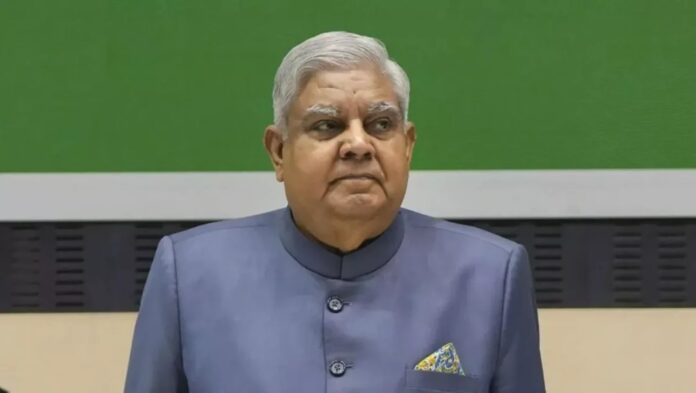

The disgraceful exit of Jagdeep Dhankhar’s term as Vice-President, cut short by his surprise resignation from the constitutional post late Monday evening is widely felt was due to forceful instructions from the Prime Minister Narendra Modi himself. Though he has been citing his health condition as a reason, everyone felt it was only an excuse to cover up serious political pressure he has been facing.
When a Vice President resigns mid-session without a single prior indication — that’s not protocol, that’s political theatre. And the script is being rewritten in real-time. Political observers felt that it only reflects the political turmoil that PM Modi has been facing in recent times.
On one hand, he has been facing strong pressures from the RSS to vacate his seat on the basis of 75 years of age to retire from active politics, the practice forcefully introduced in the BJP by himself in 2014. After failing to get an absolute majority for the BJP in 2024 elections, he is afraid to conduct a BJP MPs meeting. Even after the elections, the leader of the party in the Parliament was elected by NDA MPs, but not exclusively by BJP MPs.
Party insiders say that atleast 50 MPs are ready to question the policies of the government if they were summoned for a party MPs meeting, but he has been avoiding it. Though Dhankhar created history as the only Vice President, who attracted impeachment motion from the opposition, which was rejected on `technical reasons’.
But, the Narendra Modi-led government also said to be not happy with his `independent’ comments on the judiciary and some other sensitive issues. In the last few days, Jagdeep Dhankhar had been meeting Opposition leaders, to whom he is believed to have conveyed his deep annoyance with the government, especially the Prime Minister.
In 2022, his term as term as the Rajya Sabha Chairman began with a controversy as he called the Supreme Court’s 2015 judgment striking down the National Judicial Appointments Commission (NJAC) Act a “glaring instance” of “severe compromise” of parliamentary sovereignty and disregard of the “mandate of the people”.
He said Parliament, being the custodian of the “ordainment of the people”, was duty-bound to “address the issue” and expressed confidence that “it will do so”. The remarks, made in the House on December 7, were a reiteration of what he had said a week earlier.
The comments came at a time when the Opposition was planning to seek a discussion in the House on alleged government interference in the functioning of constitutional bodies, including a faceoff with the judiciary. A month earlier, then Union Law Minister Kiren Rijiju had said the Collegium system of appointing judges was “opaque” and “not accountable” and “alien” to the Constitution. His remarks had attracted the displeasure of the Supreme Court.
Now, at a time the government is facing ire of the Supreme Court for not acting fast on Chief Justice letter with regard to taking action on Justice Varma’s episode, Dhankar taking proactive decision of admitting the impeachment notice given by the opposition MPs, in which none of the BJP MP signed. This said to be created ire of the PM Modi fearing that would send wrong signals to the
On April 22, Dhankhar minced no words in questioning the judiciary soon after the Supreme Court imposed a three-month time limit on the President and governors to give their assent to a Bill. At a gathering at a Delhi University event to commemorate 75 years of the Constitution, Dhankhar said, “There is no visualisation in the Constitution of any authority above Parliament … elected representatives … They are the ultimate masters as to what (the) Constitution content will be.”