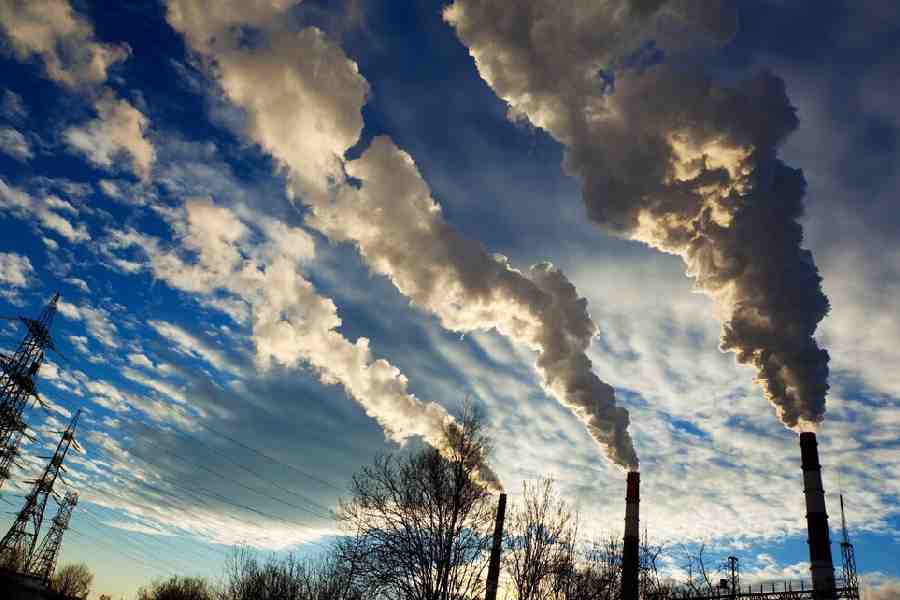
Every leading metropolis and mega city in India – including Kolkata, Bengaluru, Mumbai, Hyderabad and Chennai – has been struck by high ozone levels in the summer of 2025. Ground-level ozone pollution has spiked and concentrations have exceeded the eight-hour standards on a number of days. This has emerged from an analysis done by the Centre for Science and Environment (CSE).
The assessment highlights that unlike primary pollutants, ozone is not emitted directly from any source. It forms through intricate chemical reactions involving nitrogen oxides (NOx), volatile organic compounds (VOCs), and carbon monoxide (CO) — pollutants that are released by vehicles, power plants, factories and other combustion sources.
In the presence of sunlight, these substances undergo a series of cyclic reactions that result in the formation of ozone at ground level. VOCs also have natural sources such as vegetation, adding to the complexity. Ground-level ozone accumulates not only in urban environments but can also travel long distances, turning into a regional pollutant.
It can impact agricultural productivity and threaten food security. Given ozone’s highly reactive nature, the ambient air quality standards for it are set for eight-hour averages, instead of 24-hour averages.
Anumita Roychowdhury, executive director, CSE, says: “If unchecked, this can become a serious public health crisis as ozone is a highly reactive gas and can be harmful even with short-duration exposures”.
“In contrast to cities in north India where high summer temperatures and intense solar radiation can lead to ozone levels exceeding the standards, other cities in warm climates are experiencing consistent ozone exceedance during other seasons as well,” she added. Roychowdhury said Ozone mitigation needs drastic control over a range of gases from vehicles, industry and all combustion sources.”
The CSE review shows that exposure to ground-level ozone can inflame and damage the airways, increase susceptibility to infections, and worsen respiratory conditions such as asthma, chronic bronchitis and emphysema.
Children with underdeveloped lungs, older adults, and individuals with existing respiratory conditions are particularly vulnerable. Ozone exposure increases the frequency and severity of asthma attacks, often leading to higher rates of hospitalisation.
Sharanjeet Kaur, deputy programme manager at the Urban Lab in CSE, points out that as ozone formation depends on complex atmospheric chemistry and on photochemical reactions, its level varies across the time and space horizon. Meteorological parameters such as sunny and warm weather, stagnant wind patterns etc have a bearing on its formation.